How to Become a Plumber in Australia: The Apprenticeship, State Licences — and the Road to $100k-Plus
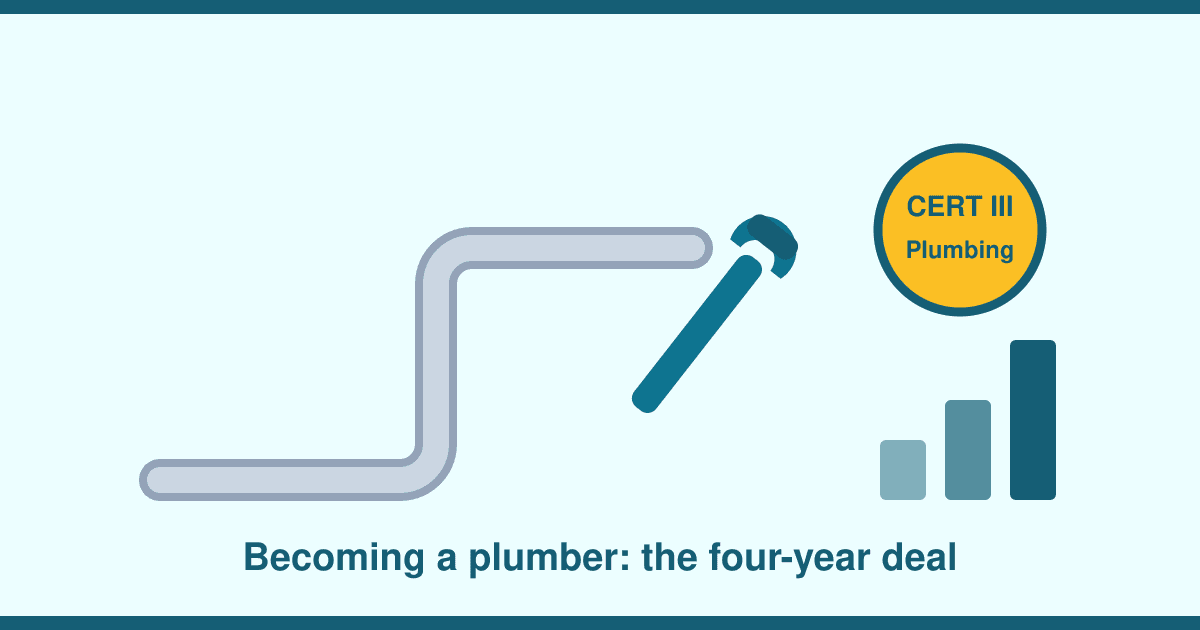
Plumbing may be the most quietly lucrative of Australia's licensed trades: entry through a standard apprenticeship, a legally protected scope of work — and a pay ceiling that overtime, endorsements and mining rosters push past $150,000. The structure is explicit, the shortage is chronic, and the path is the same four-year deal every trade offers, with one twist: the licence at the end. Here's the honest 2026 map.
In short: The route is a four-year apprenticeship combining paid site work with TAFE study toward the Certificate III in Plumbing, on wages set by the Plumbing and Fire Sprinklers Award (MA000036) — first-years start around $11–$13 an hour (~$23,000–$27,000). Qualified plumbers typically earn $85,000–$105,000, licensed base wages run $80,000–$115,000, and overtime, penalties and drainage or gasfitting endorsements regularly push totals to $120,000–$150,000+.
The four-year deal
- Sign a training contract with a plumbing employer — directly, or via a group training organisation that places you with host businesses.
- Work and study: paid site work plus TAFE blocks across installation, maintenance, roofing/stormwater, sanitary and water systems — the Certificate III curriculum.
- Climb the award wage rungs: starting around $11–$13/hr and rising each year, with adult apprentices (21+) on higher scales and busy metro employers commonly paying above award to keep good apprentices.
- Get licensed: here's the plumbing twist — the Cert III alone doesn't let you work unsupervised. Each state's licensing authority sets its own registration and licence tiers, which is exactly why "do you need a licensed plumber" differs state by state. Budget for the licensing step in your final year rather than discovering it after.
What the trade pays once you're in
| Stage | 2026 earnings |
|---|---|
| First-year apprentice | ~$11 – $13/hr (~$23,000 – $27,000) |
| Qualified plumber (typical) | $85,000 – $105,000 |
| Licensed base range | $80,000 – $115,000 |
| With endorsements, overtime, penalties | $120,000 – $150,000+ |
| Mining/FIFO roles (WA, QLD) | $130,000 – $150,000+ with allowances |
The earnings levers are worth learning early: gasfitting and drainage endorsements widen your legal scope and your invoice; commercial construction and fire services pay above domestic maintenance; and Western Australia's and Queensland's resources sector pays site plumbers city-partner salaries plus allowances for the FIFO lifestyle trade-off. Gasfitting in particular is the classic second ticket — the plumbing equivalent of a pay rise you study for.
Getting the contract
The apprenticeship bottleneck is the employer, not the course. What works: approaching small plumbing businesses directly with a white card and evident reliability; group training organisations, which manage placements and smooth employer changes; pre-apprenticeship certificates as queue-jumpers; and the time-honoured labourer-first route — six months of turning up on time converts to training contracts remarkably often. Mature-age entrants are genuinely welcome: adult apprentice wage scales exist precisely because career changers are common in the trade.
Why the licence makes the trade: plumbing work is legally restricted in every state — the licence isn't bureaucracy, it's the moat. It keeps unqualified competition out, underwrites the hourly rates customers pay, and makes the qualification portable across a career that can run from domestic maintenance to hospital hydraulics. Few four-year investments buy a legally protected occupation with this pay curve and zero student debt.
The bottom line
Four years on award wages, a Cert III, then your state's licence — into a trade paying $85,000–$105,000 typical and $150,000+ at the ambitious end, with endorsements as the built-in promotion ladder. Chase the training contract harder than the course, plan the licence into year four, and let the shortage do the negotiating. For homeowners on the hiring side: find licensed plumbers near you here.
Frequently asked questions
Four years: a training contract with an employer plus the Certificate III in Plumbing through TAFE, followed by registration or licensing with your state’s authority — which is required before working unsupervised and differs by state.
Wages are set by the Plumbing and Fire Sprinklers Award (MA000036): first-years start around $11–$13 an hour (about $23,000–$27,000), rising each year, with adult apprentices on higher scales and many metro employers paying above award.
Typically $85,000–$105,000, with licensed base wages of $80,000–$115,000. Overtime, penalty rates and drainage or gasfitting endorsements regularly push totals to $120,000–$150,000+, and mining-sector FIFO roles in WA and Queensland exceed $130,000–$150,000 with allowances.
Yes — plumbing is a licensed trade nationwide, but each state and territory runs its own licensing authority, tiers and requirements on top of the Certificate III. Plan the licensing step into your final apprenticeship year, and add endorsements like gasfitting to expand your legal scope and earnings.